Nicaragua Solidarity Campaign Action Group


27 October 2026
Teacher Learning Exchange in Nicaragua
By Joana Pujol
Bio: Joana teaches French and Spanish at The Hurlingham Academy in Fulham and was a member of the 2026 Nicaragua Teacher Learning Exchange.
This article was first published in the magazine of the National Education Union (NEU) ‘Educate’ October 2026
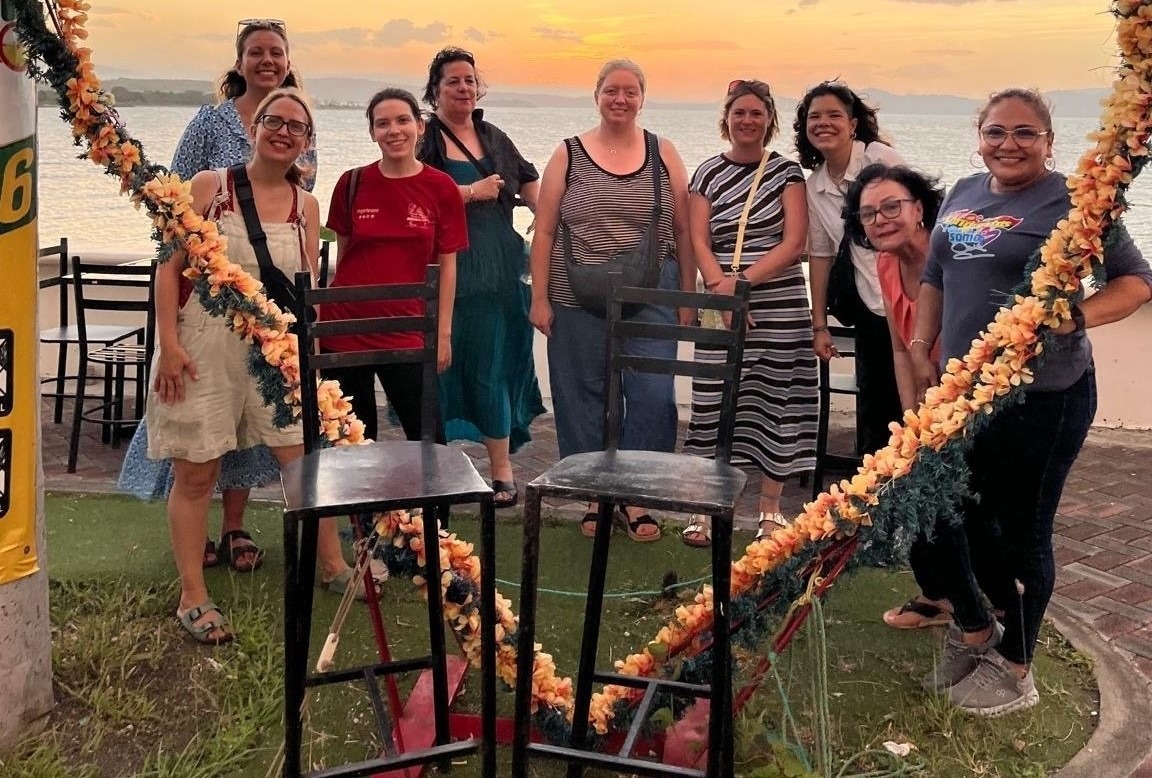
Pictured above: Members of the NEU delegation with their Nicaraguan colleagues
In August 2026, eight NEU members who are modern foreign language teachers travelled to Nicaragua as part of a Teacher Learning Exchange. The exchange, which has been running since 2017, is a joint project between the NEU, the Nicaraguan teachers’ union ANDEN and the UK-based Nicaragua Solidarity Campaign Action Group (NSCAG).
For many of us, it was our first experience of participating in an international delegation and observing first-hand how English language teaching is delivered in Nicaragua’s public schools. The bilingualism project, a national programme that began in 2018 in primary schools and is now growing rapidly, is about more than learning English. It is about widening horizons for young people who see language as a pathway to employment, mobility and cultural exchange
Education in Nicaragua is not simply a public service: it is a political project rooted in dignity, sovereignty and collective struggle
Nicaragua has treated education as a cornerstone of nation-building and a tool to expand opportunity and reduce inequality. This delegation allowed us to witness how those principles are lived today in classrooms, communities and public institutions.
Learning from Nicaragua’s bilingualism programme
Throughout our visit, we spent time in a wide range of schools: preschools full of energy, primary classrooms buzzing with songs and games, secondary schools tackling ambitious content, the Escuela Normal where future teachers are trained, and even a Saturday countryside school serving rural communities. Each place had its own challenges, but one thing was constant: students’ enthusiasm for learning English.
A lot of that motivation comes from their teachers, who, despite limited resources, showed incredible commitment and creativity. They welcomed us warmly, asked thoughtful questions, and were eager to share their practice. Many told us how much they value continuous professional development, and we could see how hard they work to make lessons meaningful and engaging. Their pride in their role was unmistakable.
The impact of free school meals
One of the most striking things we learned was how the merienda escolar programme operates. Every child, in every stage of education, receives a daily portion of nutritious food from the Government. Watching students line up for their meal with such normality made it clear how central this programme is to educational access, equality and wellbeing.
At its core, the programme is a poverty-reduction strategy. By ensuring that every child receives a daily portion of nutritious food, the state removes one of the most persistent barriers to educational access.
Solidarity across borders
Our visit directly benefited Nicaraguan teachers of English by offering practical pedagogical support, professional affirmation and strengthened international solidarity.
The delegation validated Nicaraguan teachers’ creativity, commitment and the strong cultural grounding present in their classrooms. Teachers understood that their work, in often challenging conditions, is valued internationally, and that they are part of a wider collective struggle for public education, dignity and social justice.
As NEU teacher trade unionists, we also recognised the political significance of solidarity. ANDEN’s leadership welcomed us not as visitors but as compañeros, ensuring we understood the historical and social context in which Nicaraguan teachers work.
Their commitment to public education — and their pride in defending it — reminded us that international solidarity is not symbolic. It is a shared struggle for dignity, professional respect and the right of every child to learn.
Witnessing how Nicaraguan teachers innovate with limited resources, build strong classroom communities, and centre cultural identity in language learning gave us insights we will carry back into our own schools, deepening the union’s pedagogical knowledge and CPD capacity.
Importantly, the visit reminded us of an educational vision that has been eroded in the UK: the understanding of education as a right, as a public good, and as a tool to transform lives and societies. In a context where privatisation, chronic underfunding and political neglect have left UK teachers in increasingly precarious conditions, experiencing a system rooted in dignity, sovereignty and collective responsibility was politically energising.
This visit reinforced our commitment to global education justice, expanded our understanding of what public investment can achieve, and connected us to a wider movement of educators working to eradicate poverty and defend the transformative power of public education.