Nicaragua Solidarity Campaign Action Group


29 April 2026
Human rights: the collective rights to peace, development, a clean, healthy, sustainable environment, and respect for international law
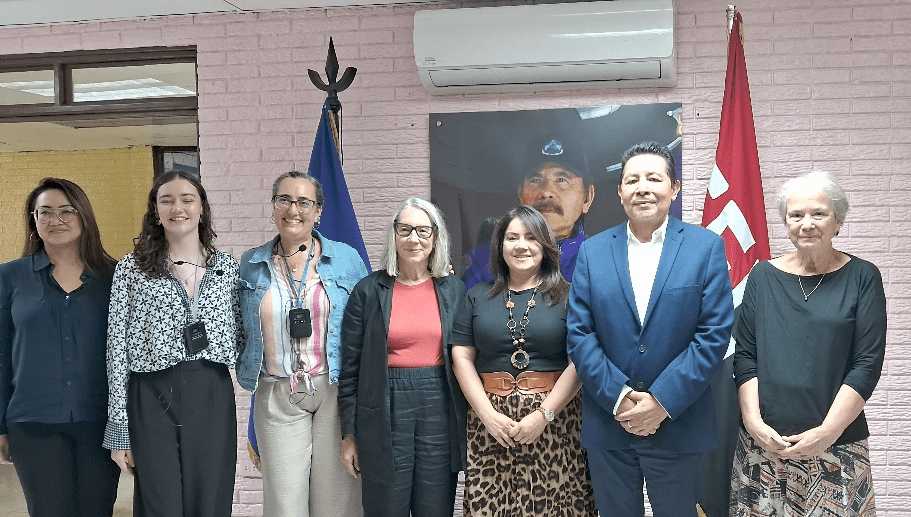
Members of, the US National Lawyers Guild (NLG) delegation visited Nicaragua in January and met with officials from the Ministries of Health, Education, Youth, and Prevention and Mitigation of Disasters. Pictured above delegation members with Minister of Education Wendy Arauz and Salvador Vanegas, presidential advisor for education. This report, written by international human rights lawyer Martha Schmidt, was first published by Nicanotes 16 April, 2026
Summary of findings:
The focus of the delegation was Nicaragua’s perspective on human rights that places emphasis on social, economic and cultural rights (ESCR). This includes collective rights to peace, development, a clean, healthy and sustainable environment and respect for international law. All these rights are interdependent.
US imperialism has created a hierarchy of rights with religion, free speech and property ranked above health, housing, education and an adequate standard of living. For the US there is no such thing as collective rights.
The delegation focused on building a relationship of understanding and solidarity based on these human rights with a particular interest in health.
In exercising national sovereignty Nicaragua prioritises the rights to health, education, housing, an adequate standard of living, and rest, leisure and participation in cultural life. The eradication of extreme poverty is a priority in Nicaragua’s development plans and budgets.
Nicaragua’s achievements in gender equality at all levels are particularly notable. Women have gained this level of equality because of the state’s commitment to ESCR, especially universal education and health care.
The US has imposed Unilateral Coercive Measures (UCMs) on Nicaragua in a deliberate attempt to damage the country’s ability to fulfil the human rights of its population. Another, even more draconian bill was introduced to Congress at the end of last year that would further tighten UCMs.
Nicaragua has an exemplary record of respecting international law and contributing to UN institutions. Some examples include: holding the presidency of the UN General Assembly in 2008-9 and winning a ground breaking case against the US for breaches of international law during the contra war. Nicaragua has drawn on this experience more recently to prosecute Germany in the ICJ for being complicit in genocide in Gaza.
———————————————————————————————————
During our visit to Nicaragua, we learned how Nicaragua views international human rights, including collective rights to peace, development, and to a clean, healthy and sustainable environment all based on its emphasis on social, economic and cultural (ESC) rights, and its commitment to the institutions of international law, centered on the UN and International Court of Justice (ICJ).
The International Committee’s Human Rights Framework Subcommittee of the National Lawyers Guild recognizes that human rights begin at home, and one of our activities has been to carry out the oversight of US violations of the right to health as laid out by the UN Human Rights Council to try to hold the US accountable. Thus, we came to Nicaragua especially interested in health.
Building a relationship of solidarity based on human rights
Coming from the US, we wanted to build a relationship of solidarity with Nicaragua around human rights: to listen, try to understand history and avoid reinforcing hegemony and imperialism, not to expect Nicaraguans to mirror US priorities.
As a sovereign state, Nicaragua can be free from American Exceptionalism. (That ideology has elevated property rights over human rights and perverted human rights discourse in the US.) Knowing how exceptionalism has created hierarchies of rights, with religion and free speech ranked above health, housing, education and an adequate standard of living, and aware that the US government rejects collective rights, especially the right to peace, we hoped to learn the Nicaraguan approach. We chose economic, social, and cultural (ESC) rights as a focus, also, because a substantial minority of the US population rejects those as rights.
Our delegation had the privilege of meeting with Nicaragua’s ambassador to the UN; the central bank president; former diplomats and lawyers involved with representing Nicaragua at the UN and in litigation before the International Court of Justice; members of the National Assembly; heads of the ministries of health, education, youth, and disaster prevention and mitigation; the Managua mayor’s office; and leaders of an agricultural cooperative.
Nicaragua’s commitment to achieving gender equality
An overarching experience was seeing and hearing about Nicaragua’s commitment to achieving women’s equality, an important international human rights achievement. It is no small accomplishment that Nicaragua is globally recognized as the sixth most equal country for women! Nicaragua’s delegation to the UN is majority women. The National Assembly has over 50% women and women are equally represented in the leadership of the National Assembly Commission on Affairs of First Nations, Afro-descendant Peoples and Nations, and Autonomous Regions.
The mayor of the largest city, Managua, is a woman and her staff, whom we met, reflect the equal status of women in leadership. In our meetings with the ministries, women were both heads of the ministries or administrative branch advisors to ministries, sometimes both. These included MINSA (health), MINED (education), SINAPRED (disaster prevention and mitigation) and MINJUVE (youth).
Nicaragua advocating gender equality in COP supported by Brazil and other countries, rejected by Western governments
We also heard about Nicaragua’s efforts to bring the rest of the world up to a higher standard of equality, including at the last environmental Conference of the Parties (COP) in Rio when Nicaragua tried to get a 50% quota rule adopted for women’s participation, which Brazil supported, but which Western governments rejected.
It’s clear that women gain equality when a state makes ESC rights—especially education, health, and housing—publicly financed and freely accessible. Nicaragua’s universal, single payer-financed health care system and free schooling through university level are key.
The rights to peace and development interrelate with economic, social and cultural rights
While people in the US may be aware of the right to a clean, healthy and sustainable environment they may not have heard of the rights to peace and to development.
We learned of their importance to Nicaragua and their interdependence with individual ESC rights. They guide the domestic policies and are given priority by representatives of Nicaragua internationally.
For example, Nicaragua has long been involved in negotiations to address climate change through the UN system, advocating for the Less Developed Countries (LDCs), and was instrumental in creating the Green Climate Fund, while it transitioned to a domestic economy in which 80% of its electrical grid is from renewables according to the Ministry of Energy and Mines.
The eradication of extreme poverty is a key part of development plans
Nicaragua makes the eradication of extreme poverty a key part of its development plan and its large investment priorities are infrastructure, housing/social housing, health and education. It also has developed its own set of measurements of development, finding the World Bank focus on consumption was insufficient. (It stopped using it after 2015.) It factors in more nuanced criteria such as where people live, what kind of house they have (floor, roof, etc.), what fuel is used, their income, education, and access to water and food, as Central Bank President Ovidio Reyes told us.
Exercising national sovereignty
Nicaragua, in exercising its national sovereignty, gives priority to the rights to health, education, housing, an adequate standard of living, and rest, leisure and participation in cultural life, including technology.
We saw how human rights decisions were based on their version of a socialist society, with well being for everyone, and incorporating the Universal Declaration of Human Rights into their Constitution. The priority accorded to ESC rights is highly interdependent with the right to development and their economic conditions. In our long, informative meeting with the president of the Central Bank, Ovidio Reyes confirmed that health and education get the majority of funding.
This provided me an opportunity to think about the linkage between national priorities, budgeting and the realization of human rights, since what I see presently in the US is that, despite spending the most in the world on health care, the US has poor outcomes because the right to health is sacrificed for the profits of health capitalists.
In our meeting with the Ministry of Health (MINSA) (and from my experience in a 2024 health care delegation, I learned that to have good community-based and preventative care, and equitable outcomes you don’t need to have the wealth of the US.
But you do need political will, a good constitution and set of laws, as well as public support for health care and public health (like clean water, reduction of accidental deaths, control of insect vectors, etc.). A commitment to investment in health care facilities and services and to prioritizing the remedying of past inequality is essential as the system develops, and the more established system has to continue to adapt, funding and developing alternative remedies and products, providing new opportunities for education and training of physicians and providers to improve the health care system.
Besides constructing a system that provides universal access, free at the point of service, with priority for improving women’s health, and reducing maternal and infant mortality, health care and public health in Nicaragua are integrated in important ways, involving ministries besides MINSA, such as SINAPRED (disaster prevention and mitigation) and MINJUVE (youth).
The coordinated and humane approach to health affected me greatly, given recent disasters in the US involving fires and flooding, with loss of life and lack of effective responses for survivors. Nicaragua’s commitment and organization to protect health and save lives, among other things, resulted in zero deaths after the most recent hurricane.
We discussed US economic aggression against Nicaragua, which many rights activists in the US barely acknowledge, if they know. These are Unilateral Coercive Measures (UCMs)—also known as sanctions—adopted by both the Executive Branch and Congress against Nicaragua, which are deliberately intended to damage Nicaragua’s ability to fulfill the human rights of its people. The US uses illegal UCMs to impair Nicaragua’s ability as a sovereign state to engage in ordinary and necessary economic activities.
Some violations are years long, like blocking Nicaragua (when the FSLN is the governing party) from using the IMF, the IBRD of the World Bank, and the Inter-American Development Bank.
Despite US violations,Nicaragua operates by law and in the interests of its people, continuing to pay existing loans, serious about financing development, conducting operations accountably, and, according to the Central Bank’s president, reducing its foreign debt for the period 2006-2026 from 84% of GDP to 50% of GDP.
A current sanctions scheme we should work to stop is another bill (NICA Act) in Congress to cut Nicaragua off from loans from the Central American Bank for Economic Integration (CABEI), a bank in which Nicaragua has shares of ownership and of which the US isn’t even a member. When you consider that more than 50% of Nicaragua’s annual national budget is devoted to health care and education, the violence and potential impact on vulnerable people of US economic warfare is crystal clear.
Nicaragua’s role in UN institutions
We appreciated the unique and valuable opportunities to learn the history of Nicaragua’s roles as a UN member, including its presidency of the General Assembly (2008-2009), its ground-breaking uses of the International Court of Justice, its foreign relations with other countries in Latin America and the Caribbean, its leadership in gender equality and support for multilateralism.
We heard from Nicaragua’s Permanent Representative to the UN and other diplomats, current and retired, as well as from a lawyer who was part of team which litigated the 1986 ICJ case.
We were impressed by Nicaragua’s leadership in supporting the principle of self-determination of peoples, with its service as vice-president on the Committee for the Exercise of the Rights of the Palestinian People and long history of supporting Palestinian self-determination. Besides being the first state to petition to join South Africa’s case against Israel pending before the ICJ, Nicaragua filed its own case two years ago against Germany for complicity in genocide and other crimes.
We explored the solidarity potential of the International Court of Justice decision that Nicaragua won against the US in 1986, titled “Military and Paramilitary Activities in and Against Nicaragua” for which the US never paid court-ordered reparations (estimated to be about $17 billion),
We knew that tens of thousands of people were murdered and many more injured in the Contra War of the 1980s, and we knew about the murderous Reagan administration, which accused Nicaragua of terrorism and arms trafficking and financed the war by importing drugs from Central America into Black communities in the US.
In its 1986 decision, the ICJ rejected the phony argument of the US, that it was engaging in “collective self-defense” on behalf of the government of El Salvador in funding the Contras.
This case is now useful to mention when the Trump administration lies that Nicaragua is currently involved in drug trafficking, also because the US is resurrecting collective self-defense, along with drug trafficking and terrorism accusations, to justify murdering Venezuelan, Colombian and Trinidadian sailors on boats in the Caribbean and Eastern Pacific, according to a quasi-secret memo of the Office of the Legal Counsel of the US DOJ.
The Court’s decision in Nicaragua’s favor stands out as a high point for justice. Customary law principles (also in the UN Charter) were violated by the US: the duty not to use force against another country, the duty not to interfere in the internal affairs of another country, the duty to respect the national sovereignty and territorial integrity of another country. We learned that the decision for Nicaragua was historic.
For the Global South it was a turning point, a significant case which built confidence in the ICJ as an institution and that communicated to formerly colonized states that it might be possible to get a fair result from an international system designed by the colonizers. The Nicaragua v. United States of America decision was a “moral defeat for imperialism,” as Harold Urbina said in an interview in March 2025.
The case “Military and Paramilitary Activities in and Against Nicaragua” can be used to prevent the historical forgetting of US war-mongering and for resisting the information narrative which the US promotes continuously to confuse the US public so we will accept more war (stopping “authoritarians” and bringing “human rights”).
Nicaraguans are not confused by the US in their support for the right to peace and development. Although in 2001 the Bush administration declared the FSLN a “terrorist organization,” the FSLN was returned to power in the 2006 elections, after which they began to reverse the damage of neoliberalism.
Despite US financing of an attempted coup against Nicaragua using the National Endowment for Democracy (NED) in 2018, the coup was stopped (not without deaths and injuries and lasting trauma to people, as we heard). The 2021 elections confirmed that the vast majority of the electorate doesn’t want neoliberalism and supports the co-Presidents and the FSLN agenda.
US human rights activists who admire Nicaragua’s accomplishments must exercise vigilance so we can be in solidarity when US aggression accelerates, as it will. It’s likely to consist of NED interference, e.g. the plan to target Nicaragua with NED media funding, according to testimony by the NED head on 2/24/26 to the House Appropriations Committee. It may be military, e.g. the US 2025 National Security Strategy to prevent exercise of sovereign decisions, which for Nicaragua could especially involve relations with Cuba, Venezuela, and China.
The March 2026 statements made by Marco Rubio in Munich and Trump and SOUTHCOM leaders in Miami at “Counter-Cartel Coalition” and “Shield of the Americas” meetings may provide cover to regional right-wing leaders aligned with the US to increase militarism and justify violence launched against Nicaragua and other states with left wing governments.
We can resist in part by naming those violations of international law and by emphasizing the unfinished business of the New International Economic Order which supports popular control over economic resources as a basis for national sovereignty and territorial integrity.
(Special thanks go to Coleen Littlejohn for hospitality and for arranging the meetings for the delegation and to Becca Renk for interpreting.)